
Megan Perry and Leonie Nimmo reflect on the struggles and solidarity that were woven through ORFC 2026.
In the year since ORFC 2025, the horrors happening in Gaza have intensified, as has the rising tide of oppression in the West Bank. We have witnessed thousands of deaths, a man-made famine, and the destruction of the Palestine Local Seed Bank. But the struggles, resistance and sumud (steadfastness) of Palestinian landworkers has continued.
When organising sessions on landwork and resilience in Palestine for ORFC 2026, the oppression Palestinians face became explicit, as Palestinian speakers were prevented from attending due to Israel’s crackdown on civil society, particularly agricultural organisations.
This absence was marked in the ORFC opening plenary, where delegates from Palestine should have shared their reflections on the importance of their local heritage seeds. Instead, speakers from La Via Campesina brought the news of the destruction of the Palestinian Local Seed Bank and read a statement of solidarity which in no way compensated for the absence of Palestinian landworkers’ wisdom at the conference.
Although we lost our original delegation, thankfully Palestinian voices were not completely silenced, as others managed to attend and sessions on Palestine were seeded throughout the conference.
Za’atar and Seeds of Palestine
The story of the Palestinian herb za’atar was shared in a workshop co-hosted by the Land Stories Collective and Exeter Seed Bank. In a moving and deeply personal account, Sally Azzam described the way in which the foraging of za’atar had been banned by the Israeli state. It was then cultivated by an Israeli company, which began to sell its product to captive Palestinian markets: people hungry for a heritage food that they had been unable to access since the ban.
As participants sat and discussed this and other stories of oppression, resistance and solidarity, participants shared bread, olive oil and za’atar. We compared cultivated za’atar with the wild-harvested version, brought by Sally from Palestine. Sitting and sharing food together created a powerful but gentle space for us to contemplate Palestine, and a situation that is incredibly hard to think about.
Solidarity With Palestinian Landworkers
The Solidarity with Palestinian Landworkers session brought together Mazin Qumsiyeh, Mahmoud Zwahre, Cathi Pawson and Ruth Hancock and was facilitated by GM Freeze’s Leonie Nimmo. As a professor in biology and founder and Director of the Palestine Museum of Natural History and the Palestine Institute for Biodiversity and Sustainability, Mazin identified the impact of colonialism on diversity in Palestine and around the world. Colonialism, Mazin says, “is not just against people, it is against nature, it is against mother Earth.”
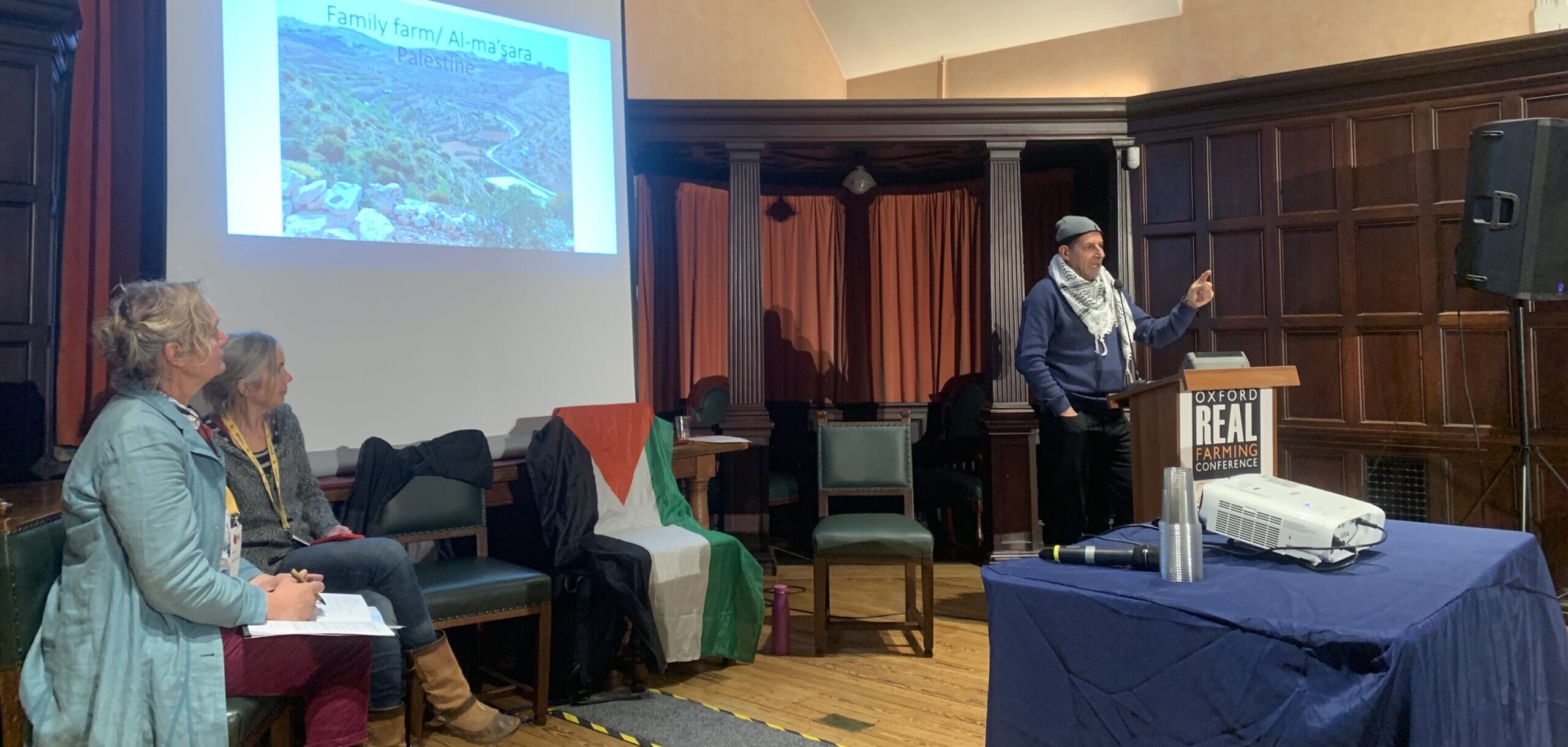
This attitude to nature was echoed by the words of Mahmoud Zwahre, a Palestinian farmer, academic and activist from Al-Ma’sara village south of Bethlehem, who we were honoured to have with us in Oxford. Mahmoud’s family farm is twinned with the Regather Organic Farm in Sheffield. The project is based on exchanging stories from both farms in order to foster hope and sustain agroecological farming practices.
Mahmoud spoke of the illegal settlements that are replacing trees in the West Bank. His village is now surrounded by 120,000 settlers, and Palestinians are now the minority in the area. The concrete forests of settlements are in stark contrast to the relationship with land that Mahmoud spoke of – what he calls the decolonial practices of sumud “steadfastness”, that are central to traditional farming and listening to the land.
In the context of colonial occupation, it is essential for farmers to continue to be producers and not turn into consumers. As Mahmoud says, “If you eat from your axe digging, your thoughts will be independent and you will be able to lead a revolution.”
This is why Israel has targeted farmers in particular. Cathi Pawson, co-founder of Zaytoun, spoke about how the last two years have seen intensified pressure on Palestinian farmers. The last olive harvest was the most difficult in memory: trees were burnt, settler attacks ramped up, roads were closed and farmers faced daily intimidation.
Twinning Farms
Another form of solidarity is through farm twinning, which has been pioneered by the Landworkers’ Alliance. Ruth Hancock’s veg farm in Devon is twinned with a farm in the West Bank to whom she speaks a couple of times a week, and this is one way we can strengthen our connection and solidarity.
Ruth read one of the messages from the Palestinian farm, “It was a year full of events and a difficult year for us, however, thanks to you, your courage, your help, your support, and your sharing of concerns, our resilience has increased and our confidence has grown that people still carry goodness, love and cooperation and the future belongs to those who embrace a culture of peace, love, cooperation and partnership. We dream of a better future for us and for you.”
Landworkers’ Alliance member Ed Gardener and Talamh Beo’s Oliver Moore highlighted the need for us to pivot our approach to twinning, because of the way civil society is being targeted. An even more grass-roots approach may be needed moving forwards.
Mahmoud said, “I am here today in order to urge you to build relationships with Palestinian farmers. Twin with Palestinian farmers. We don’t want to be alone. Do not underestimate any single action you are doing here, This brings hope to Palestinians on the ground”.
And finally, Mazin urged us to ask ourselves where to spend our resources both in money and time because his struggle is our struggle, and our struggle is his. This is a colonial project that reaches much farther than Palestine. We must all think about what would make a difference and contribute towards a global movement and the revolution that needs to happen. Because, as Mahmoud says, “liberating Palestine is liberating the world.”
Your Struggle is My Struggle
Farmers at ORFC 2026 may have asked themselves: What can we do in the face of such massive oppression and power imbalance? It is easy to feel hopeless, but the speakers were clear. No action is too small and everyone can do something, from supporting Apartheid-Free Zones and the Boycott, Divestment and Sanctions (BDS) movement, to buying Palestinian products or hosting a fundraising event or meal, to visiting Palestine and volunteering in the community, to twinning your farm.
ORFC embedded Palestinian perspectives in the programme this year, with speakers from Palestine due to participate in four different sessions and the opening plenary. Though this wasn’t possible, the message of the opening plenary rang throughout and beyond the conference: “If we allow a world where saving seeds, food sovereignty and fundamental human rights, are targets of occupying soldiers and colonial oppression, then we ourselves are lost. This is a fight that we are in together. This is our shared struggle.”